

When evaluating ground support equipment, two terms are often used interchangeably: towbar pull and towing capacity. While they are closely related, they represent different aspects of a tractor’s performance—and misunderstanding the difference can lead to improper equipment selection.
Understanding how towbar pull and towing capacity relate to one another is essential for selecting the right equipment for your operation and ensuring safe, reliable performance in the field.
What Is Towbar Pull?
Towbar pull refers to the amount of pulling force a tractor can exert at the hitch point. It is typically measured in pounds (lbs) or Newtons and represents the force available to move a load.
In simple terms:
Towbar pull = the tractor’s ability to generate pulling force
This force depends on several factors, including:
• Vehicle weight
• Tire type and traction
• Surface conditions
• Drive system configuration
A higher towbar pull means the tractor can apply more force to start and move a load, particularly in challenging conditions such as inclines or low-traction surfaces.
What Is Towing Capacity?
While towbar pull defines available force, towing capacity reflects how that force translates into real-world movement.
Towing capacity refers to the maximum weight a tractor is rated to move under specified conditions. This is typically expressed as total load weight (including carts, trailers, or aircraft).
In simple terms:
Towing capacity = how much total weight the tractor can safely move
However, towing capacity is not determined by towbar pull alone. It is influenced by:
• Rolling resistance of the load
• Grade (incline or slope)
• Surface conditions
• Operational speed
• Braking capability
This means that a tractor’s towing capacity can vary depending on the environment in which it is operating.
Key Difference Between
Towbar Pull and Capacity
The key difference comes down to force versus load:
• Towbar Pull measures the force the tractor can apply
• Towing Capacity measures the weight that force can move
A tractor may have sufficient towbar pull, but if conditions increase resistance (such as rough surfaces or inclines), the effective towing capacity will be reduced.
Similarly, two tractors with similar towing capacity ratings may perform differently depending on their towbar pull and traction capabilities.
Understanding the Relationship
While towbar pull and towing capacity are often listed as separate specifications, they are directly related through basic mechanical principles.
At a simple level, the force required to move a load depends on resistance. This includes rolling resistance, surface conditions, and any incline the tractor must overcome.
In practical terms:
Required Force = Load Weight × Resistance Factors
To better understand this relationship, it helps to compare how the same load behaves under different operating conditions.
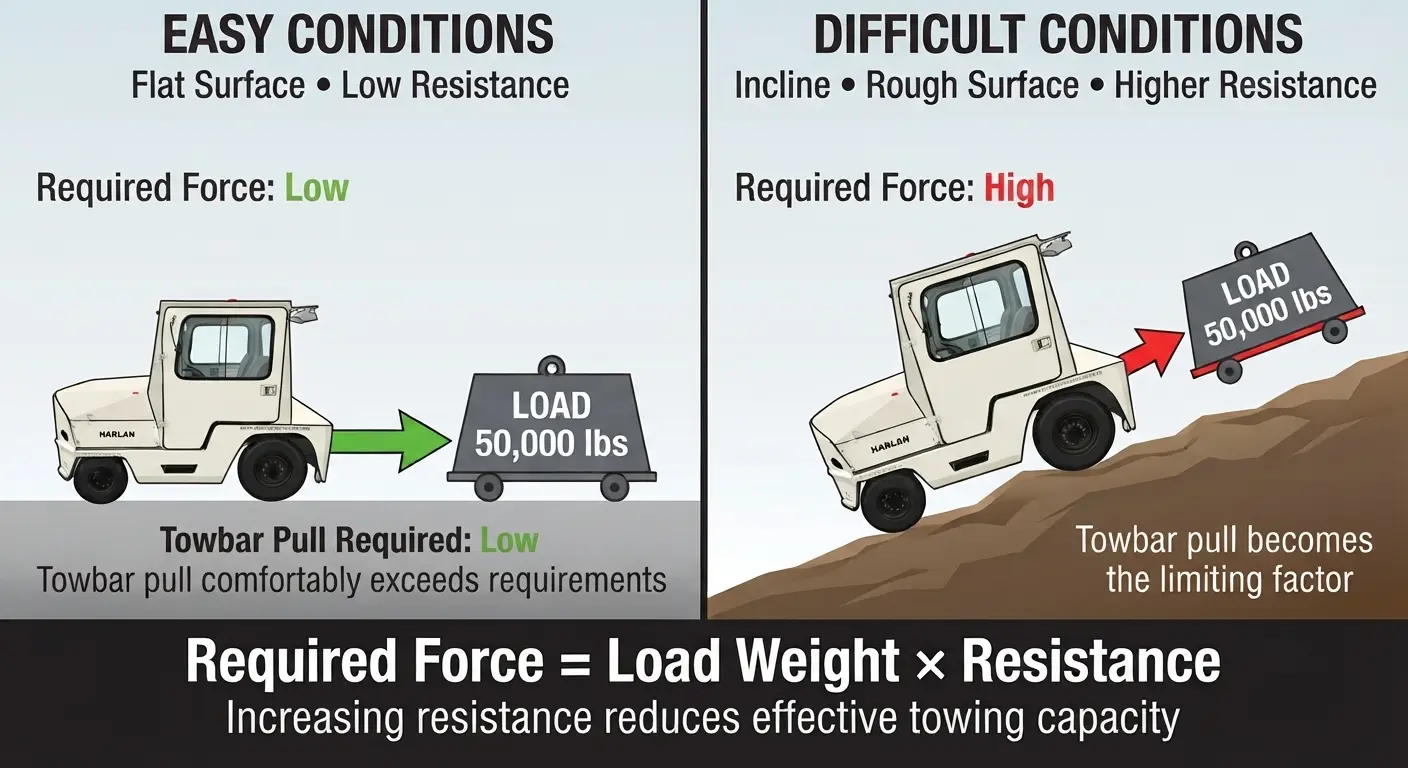
Under ideal conditions—such as a flat, smooth surface—resistance is low. This means less force is required for a tractor to move a given load, allowing it to operate efficiently within its rated towing capacity.
However, as operating conditions become more demanding the required force increases. Factors such as inclines, rough pavement, or additional rolling resistance can significantly increase the effort needed to move the same load. In this cases, the same tractor may struggle, not because the load has changed, but because the required force now approaches or exceeds the available towbar pull.
As shown above, the same load can require very different levels of force depending on operating conditions. In these situations, the available towbar pull may begin to approach its limit, making it more difficult for the tractor to start or sustain movement.
Another way to think about this relationship is:
Approximate Capacity ≈ Available Towbar Pull ÷ Resistance (or Grade)
As resistance increases—even slightly—the effective towing capacity decreases. This is why a tractor that performs well on flat surfaces may not perform the same way on ramps, uneven terrain, or in adverse conditions.
This is why both values must be considered together when evaluating equipment performance.
Why the Distinction Matters
Understanding the relationship between towbar pull and towing capacity ensures that equipment is properly matched to the application.
Selecting a tractor based solely on towing capacity without considering towbar pull can result in:
• Difficulty starting loads
• Reduced performance on inclines
• Increased wear on equipment
• Potential safety concerns
On the other hand, understanding both values allows operators and procurement teams to make informed decisions based on real operating conditions—not just specifications on paper.
How This Applies in Practice
For example, moving a set of baggage carts across a flat, smooth ramp requires relatively little force. In this scenario, a tractor may operate well within its rated towing capacity.
However, introduce a slight incline, uneven pavement, or wet surface conditions, and the force required to move that same load increases significantly. While the towing capacity rating hasn’t changed, the available towbar pull may now become the limiting factor.
In both cases, the load weight remains the same—but the conditions determine how much force is actually required to move it.
This is why evaluating both towbar pull and towing capacity together is critical for real-world performance.
Conclusion
Towbar pull and towing capacity are closely related but serve different purposes. Towbar pull defines the available force, while towing capacity reflects the practical load that force can move under specific conditions.
By understanding both, operators can ensure they are selecting equipment that performs reliably, safely, and efficiently in real-world conditions.
Understanding Towbar Pull vs. Towing Capacity in Ground Support Equipment